Thursday, February 9, 2012

Paris as first major city to pass the law!

From systematicfailure.wordpress.com

You’ve heard of the Idaho Stop Sign Law? Well, get ready for the Paris Red Light law:
Parisian cyclists have won the right to go through red lights following a fierce debate over their claim that the move would reduce the risk of road accidents. A three-year campaign by cyclists’ associations — which say it is idiotic for them to stop at traffic lights — bore fruit when the Government published a decree authorising councils to change the rules.
Paris will be among the first major cities to try out the new system after councillors approved a plan to allow bicycles to turn right or to go straight at a T-junction even when the lights are red.
Thousands of cyclists are fined in the city every year for failing to stop at “un feu rouge”.

Tuesday, February 7, 2012

What bike/ped projects are most important to you?

From VTBikePed
Now, for the first time since 2005, a particular door is opening to provide an avenue to advance bike/ped projects. You can let decision makers at the local level know which projects are most important to you so they can consider your input prior to submitting a report to VTrans which is due March 1.


Background: Vermont has a number of regional planning commissions or RPCs. Each RPC has a Transportation Advisory Committee or TAC which assembles data on which bike/ped projects are most needed/wanted and then forwards that list to VTrans. Communicating through the TACs is the best way to let VTrans know that a particular bike/ped project is important to residents of a particular region.

The revenue stream that is starting to flow again is part of the line item in the VTrans budget for bike/ped projects. Applications for funding stopped being accepted by the Douglas administration in 2005. Now that such a long period of time has passed, the Shumlin administration wants to find out what has changed in the past seven years. Have communities re-ordered their priorities? What's wanted where? Sidewalks? Bike lanes? Bike paths?

Please take a few minutes to be sure that your regional TAC hears what bike/ped projects are most important to you. If you don't have the contact info for the TAC and RPC that represent you, please consult the list below. Thank you for seizing this opportunity to let decision makers know that the bike/ped community in Vermont is concerned, vocal, and vibrant. If the transportation planners at the RPCs don't hear from the bike/ped community, important bike/ped projects may be by-passed in the competition for limited dollars.

Addison County: Adam Lougee, alougee@acrpc.org
Bennington County: Mark Anders, manders@bcrcvt.org
Central Vermont: Steve Gladczuk, gladczuk@cvregion.com
Chittenden County: Bryan Davis, bdavis@ccmpo.org
Lamoille County: Amanda Holland, amanda@lcpcvt.org
Northeastern VT: Doug Morton, mmorton@nvda.net
Northwestern VT: Allison Stori, astori@nrpcvt.com
Rutland: Susan Schreibman, susan@rutlandrpc.org
Southern Windsor: Katharine Otto, kotto@swcrpc.org or Jason Rasmussen, jrasmussen@swcrpc.org
Two Rivers--Ottauquechee: Rita Seto, rseto@trorc.org
Windham: Matt Mann, mmann@sover.net

Monday, February 6, 2012

Road Diets now proven safety measure; Q&A with FHWA Associate Administrator Furst

From the League of American Bicyclists

In January, the Federal Highway Administration (FHWA) Office of Safety placed Road Diets on the official list of Proven Safety Countermeasures. States are actively encouraged to use the listed safety countermeasures and FHWA provides guidance on their application. Road Diets slow traffic by reducing car travel lanes and replacing them with things like bike lanes and center turn lanes.

Before and after photo of Philo Road in Urbana, IL, from www.vtpi.org, provided by the City of Urbana.
To learn more about how Road Diets came to be added to the list and the practical implications of this move, we had some questions for FHWA Associate Administrator for Safety Tony Furst. Mr Furst was kind enough to take some time to talk about the safety benefits of Road Diets for all road users.
League:  What is the process by which a safety measure is added to the list?
Administrator Furst: FHWA assembled experts from across the agency to research
effective countermeasures in three primary areas – intersections, roadway departure, and pedestrian safety.  In its evaluation, the team assessed the implementation of countermeasures
Tony Furst, FHWA Associate Administrator for Safety
across the country, what we know about the countermeasures from the Crash Modifications Factors Clearinghouse – a comprehensive repository of research and evaluations
for safety countermeasures, and peer reviews by researchers and professional engineers from across the road safety field. Ultimately, the nine were chosen based on the quality of the research that shows that they are proven safety countermeasures and are ready to be widely implemented.
A Road Diet is an increasingly popular countermeasure that is very compatible with a Complete Streets application and one that FHWA promotes in the “Designing for Pedestrian Safety” courses – it is an excellent safety countermeasure and works well on many levels.
League:  What are the safety benefits for drivers? What are the safety benefits for bicyclists and people on foot?
Administrator Furst: Road Diets reduce vehicle speed which makes the roadway environment safer for all road users.  For bicyclists in particular, road diets often include bike lanes, a plus for the cycling community.  For pedestrians, this countermeasure slows vehicles in the midblock area.  Since 70 percent of pedestrian fatalities occur at midblock crossings, road diets can definitely help save pedestrian lives.
League: What can advocates do to encourage their state DOTs to undertake Road Diets? 
Administrator Furst: When a State or municipality identifies a safety issue that can be improved by the application of a road diet, safety advocates can support its implementation.  When safety advocates bring their issues to a State DOT or municipality, it helps if they can bring potential solutions, and if road diets improve the issue being brought forward, it could be that solution.
My Signature

DARREN FLUSCHE
LEAGUE POLICY ANALYST

Flusche joined the League in April 2009 and has a B.A. in history from Syracuse University and a Masters of Public Administration with a concentration in public policy analysis from New York University.

State explains salt brine use

From the Burlington Free Press

Like our neighboring states, Vermont adheres to a "Safe Roads at Safe Speeds" policy during storm events. Delivering "bare roads" during a storm is simply not possible. However, we are constantly working to deploy new technologies and methods to improve safety for the traveling public and efficiency in the expenditure of their tax dollars. One new initiative that has been garnering attention lately is the use of salt brine. It's important to understand what salt brine is and how it differs -- or doesn't -- from conventional road salt.
Road salt is the same as the salt on the dinner table, NaCl, just bigger particles and not as clean. Salt brine is nothing more than salt and water. You can drop dry salt particles in a pile of snow, or mix salt particles with water to make salt brine -- you end up with the same thing, NaCl and H2O. In fact, our salt brine is made with the same salt that we are already spreading on the highways.
At times VTrans will mix additives into dry salt or salt brine to make the salt work better at lower temperatures. We mostly use a product called Ice B' Gone that is essentially water, molasses and magnesium chloride (another kind of salt). Ice B' Gone also makes the salt or brine sticky so it stays on the road better and has been documented by our own field testing, as well as other organizations such as the Pacific Northwest Snowfighters Association, to be less corrosive than salt. In fact, Ice B' Gone is rated by the EPA as being "Designed for the Environment."
Using sand and chlorides has a cumulative, detrimental effect on the environment. When we allow them into our water ecosystems it doesn't break down; it stays there until it's removed. Since large-scale removal is not technologically or economically feasible, it behooves us to limit the amount of sand and salt entering the environment.
That is precisely the aim of the salt brine effort -- it allows us to use less sand and salt while still providing a safe road for travelers. For example, in 2000-2001, total snowfall in Burlington was 122 inches. 16,540 tons of salt and 9,180 cubic yards of sand were required to maintain the state highways in the district. During 2010-2011, Burlington saw 128 inches of snow and that same district, using salt-brine, used about 11,000 tons of salt and 7 cubic yards of sand. The savings of 5,540 tons of salt and 9,170 cubic yards of sand is due -- at least in part -- to the use of salt brine. VTrans is confident that continued research, training and experience, will assist in the achievement of even greater savings without sacrificing safety. 

Thursday, February 2, 2012

Horrible Surface Transportation Bill Unveiled Today — Bicycle Programs Eliminated

From the league of american bicyclists

Moments ago, Congressman John Mica (R-FL) announced the introduction of the American Energy and Infrastructure Jobs Act. The proposed bill eliminates dedicated funding for bicycling and walking as we feared, and it goes much further and systematically removes bicycling from the Federal transportation program. It basically eliminates our status and standing in the planning and design of our transportation system—a massive step backwards for individuals, communities and our nation. It’s a step back to a 1950s highway- and auto-only program that makes no sense in the 21st century.
The bill (soon to be available on transportation.house.gov) reverses 20 years of progress by:
• destroying Transportation Enhancements by making it optional;
• repealing the Safe Routes to School program, reversing years of progress in creating safe ways for kids to walk and ride bicycles to school;
• allowing states to build bridges without safe access for pedestrians and bicycles;
• eliminating bicycle and pedestrian coordinators in state DOTs; and
• eliminating language that insures that rumble strips “do not adversely affect the safety or mobility of bicyclists, pedestrians or the disabled.”
On Thursday, the House Transportation and Infrastructure (T&I) Committee will mark-up the bill and Representatives Petri (R-WI) and Johnson (R-IL) will sponsor an amendment that restores dedicated funding for Transportation Enhancements and Safe Routes to School. Representatives Petri and Johnson can only be successful if everyone with a stake in safe sidewalks, crosswalks, and bikeways contacts their representative today.
Because of these urgent new developments, and the vital importance of a HUGE turnout on Capitol Hill in March, the National Bike Summit early bird registration deadline has been extended to Feb 20. We need every single cyclist in Washington, D.C. that the city can hold (and that’s thousands …). Register today!
Stay in touch by visiting bikeleague.org and americabikes.orgfor background and breaking news.
My Signature

ANDY CLARKE
LEAGUE PRESIDENT

Clarke was appointed to the position of Executive Director in April of 2004 after successfully leading efforts to create, interpret and implement the various transportation programs that are available to improve conditions for bicycling and walking as the League’s State and Local Advocacy Director.

Wednesday, February 1, 2012

House Bill Reverses Decades of Progress on Bike/Ped

From the League of American Bicyclists


TAKE ACTION NOW! Enter Your Zip Code


House Bill Reverses Decades of Progress on Bike/Ped
It’s so much worse than we thought

Today, the House released its transportation bill, the American Energy and Infrastructure Jobs Act. We expected the bill to be bad news for biking and walking, but we didn’t think it would go so far as toreverse all the progress we have made in the past twenty years.
Take action now—tell your representative to preserve biking and walking in the Transportation Committee.
House leadership is exerting pressure to completely cut bicycling and walking out of transportation. Lawmakers seem to have gone through line-by-line to gut programs that make streets safer. The outrageous American Energy and Infrastructure Jobs Act:
  • Destroys Transportation Enhancements by making the program optional
  • Repeals the Safe Routes to School program, reversing years of progress in creating safe ways for kids to walk and ride bicycles to school
  • Allows states to build bridges without safe access for pedestrians and bicycles
  • Eliminates bicycle and pedestrian coordinators in state DOTs
But there’s still a chance to save biking and walking. This week, Representatives Petri (R-WI) and Johnson (R-IL) plan to stand up to leadership by offering an amendment that restores dedicated funding for Transportation Enhancements and Safe Routes to School.  Representative Petri and Johnson can only be successful if everyone with a stake in safe sidewalks, crosswalks, and bikeways contacts their Congressional Member today. 
This is as urgent as it gets. If members of the Transportation Committee are going to stand up to House leadership by supporting biking and walking, they will need to know their constituents are behind them. Please contact Congress today and ask them to preserve dedicated funding for biking and walking.
Thank you for all you’re doing to preserve biking and walking.


TAKE ACTION NOW! CLICK HERE to Enter Your Zip Code

Contact your Representative today

From bicycledesign.net
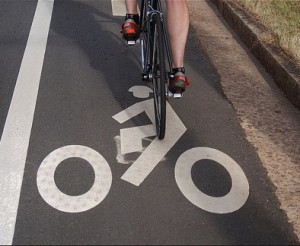
A bike lane marking in Greenville, SC
I have a backlog of design related topics that I have been meaning to discuss here at Bicycle Design, but those posts are going to have to wait… at least one more day. This morning, I want to take a minute to mention the American Energy and Infrastructure Jobs Act, which was proposed yesterday in the US House of Representatives by Congressman John Mica of Florida. In his announcement, Mica said, “This bill will put Americans back to work rebuilding our roads and bridges and developing new sources of low cost energy.” OK, putting Americans back to work sounds good on the surface, but how does eliminating the already miniscule percentage of funding going toward  bicycle and pedestrian projects further that goal? As US Secretary of Transportation Ray Lahood’s Fast Lane blog pointed out last yearbicycle projects created nearly twice as many jobs per dollar spent than typical road projects.”
Highways and Transit Subcommittee Chairman John J. Duncan of Tennessee went on to say, “These jobs will also greatly improve highway safety. Highway fatalities have steadily declined in recent years, and the funding provided in this bill will work to continue improving safety.” Again, that may sound good as a soundbite, but he failed to mention the fact that, while car deaths have dropped, pedestrian and cycling fatalities have INCREASED in recent years. The press release states that this new bill does not contain any of the numerous “earmarks” that were found in SAFETEA-LU. I assume that Transportation Enhancementsand Safe Routes to School, two programs that would both be eliminated under this bill, are two of the earmarks to which they are referring.  If they really want to address the issue of wasteful spending, the House Highways and Transit Subcommittee should look at the indirect and hidden costs associated with our automobile centric system (the most heavily subsidized transportation system in the world). Ken Kifer, who was tragically killed by a drunk driver while cycling in 2003, wrote a great piece on his website discussing the true cost of automobile use.  More recently, an article in the New York Times yesterday provided an economist’s perspective on the issue of traffic congestion. We are facing a transportation problem that cannot be solved by building more and more roads just for cars, but that is exactly what this new bill aims to do.
The League of American Bicyclists states that this bill would “reverse all the progress we have made in the past twenty years.” That is a bold statement, but not one that is off the mark. The Highways and Transit Subcommittee will vote on this bill tomorrow morning before a full House vote soon after, so it is very important that you voice your opinion today. The LAB,America Bikes, and Transportation for America all have links that you can use to contact your contact your Representative.  Congressman Tom Petri of Wisconsin will offer an amendment that restores funding for Transportation Enhancements and Safe Routes to School programs, but it won’t pass without strong support from cyclists all across the country. Take a minute right now to let Congress know that you care about bicycle transportation.  As the LAB mentioned in their call to action, this is as urgent as it gets!