Construction is starting on the long-awaited Lamoille Valley Rail Trail (LVRT), a four season multi-use recreation trail. The groundbreaking will take place on Friday, July 19 at 5 p.m. at the site of the soon to be constructed bridge on Mt Vernon Street in St. Johnsbury. Senator Bernie Sanders, a major force behind the realization of the LVRT has been invited, as well as many other dignitaries who see this rail trail as an economic and recreational engine for the area. The public is urged to attend this celebratory event and see how enthusiasm, patience and hard work has made the trail a reality.
The LVRT is a partnership of VTrans and the Vermont Association of Snow Traveler (VAST). The LVRT will eventually cross the state of Vermont, over 90 miles, from St. Johnsbury to Swanton. After a lengthy process, VAST received an Act 250 permit for phase 1 of the 3 phased project and is now poised to begin the construction phase. Once complete, the LVRT will be the longest rail trail in New England.
Construction on Phase 1a, approximately 13.5 miles from St. Johnsbury to W. Danville, will begin this summer with the building of the bridges on Mt Vernon Street and the over the “Cahoon washout” in Danville. Blow and Cote, Inc. from Morrisville, VT was awarded the contract for the Phase 1a bridges. Dufresne Group will serve as inspectors on the job.
The public is invited to come see what’s happening, what’s planned and to learn the benefits from this trail, as well as how to help make it a truly first class recreation facility.
There is limited parking on Mt. Vernon Street, as well as parking at the Park and Ride on Rt 2 and the vacant lot across from the Fairbanks Motor inn. Parking is also available at the Three Rivers Recreation Path trailhead off of South Main St in St. Johnsbury, reaching the site of the groundbreaking by walking one mile along the Three Rivers Path.
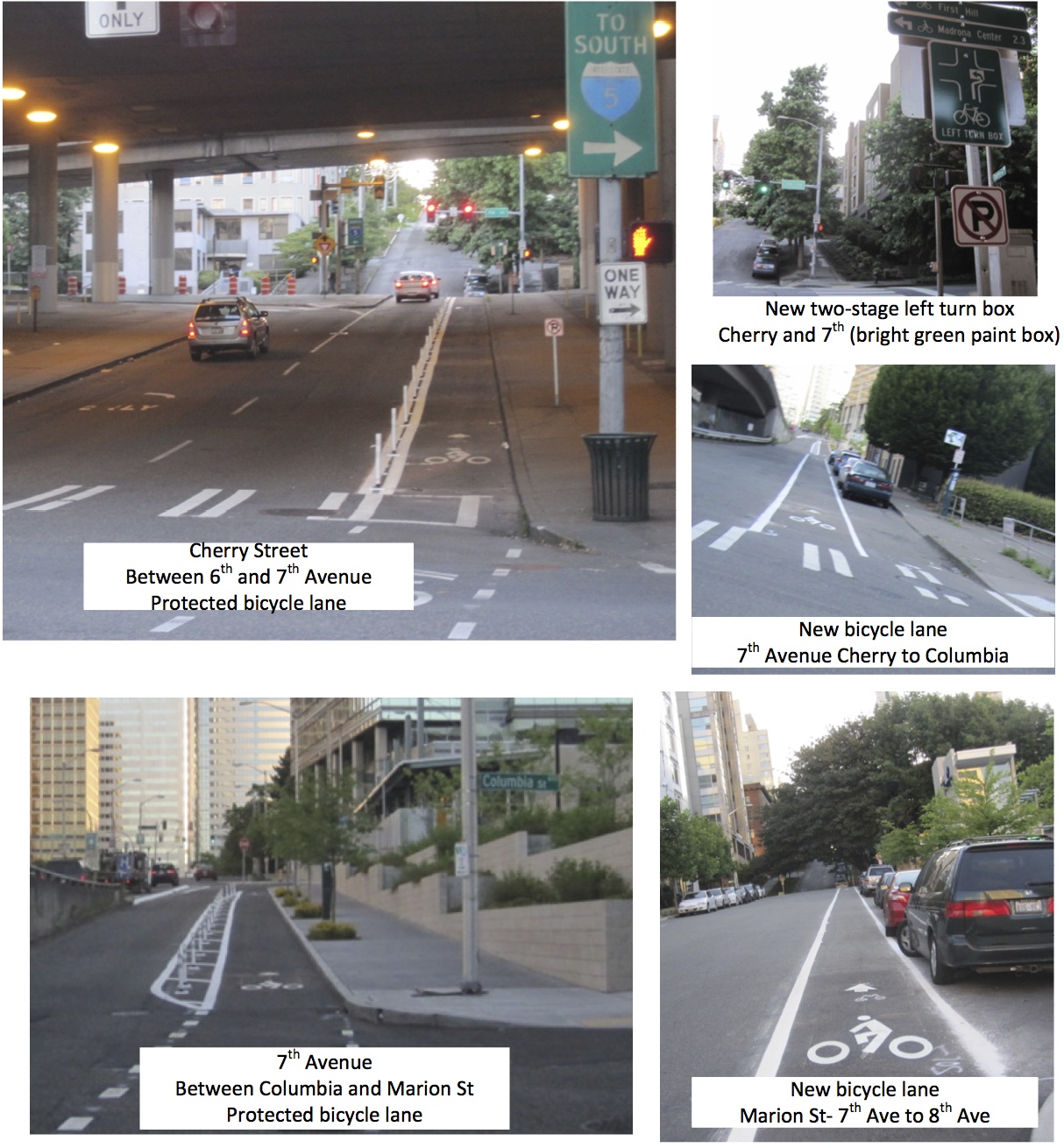
Remember when an anonymous bike safety group calling themselves “Reasonably Polite Seattleites” installed a series of plastic pylons on Cherry Street to demonstrate how easy it would be for the city to turn a regular bike lane into a protected one?
Well, the city took their advice and not only reinstalled a more resilient style of reflective pylons, but also extended the bike lane to connect downtown to First Hill via 7th Ave and Marion:
From SDOT
To recap, the anonymous group installed the pylons under the cover of night this spring. They then sent an email to Seattle Bike Blog and SDOT explaining why they did it and pointing out the fact that they used a simple adhesive to make them easy to remove should SDOT choose to do so.
In many other cities, such acts are met with scorn and threats of legal action from city officials. But Seattle’s Traffic Engineer Dongho Chang did not. Instead, he wrote an equally polite email back apologizing for the fact that they needed to remove the pylons, but thanking the group for making a statement about road safety.
Well, now Chang and the city have gone a step further. They have installed permenent pylons with safe clearance space for bike handlebars and extra buffer space on the roadway. They also completed a safer connection to First Hill by installing a bike lane on 7th Ave between Cherry St and Marion, which is a signed bike route across First Hill that will soon connect to the Broadway Bikeway when it is completed.
Here’s Chang’s email to the group and Seattle Bike Blog:
Hello reasonably polite Seattleites,
I have good news to share. SDOT worked with WSDOT to reinstall your thoughtful protector treatment on Cherry Street. SDOT and WSDOT agreed to monitor the installation to determine if additional changes need to be made. We also took this unique opportunity to make additional improvements. We installed a two stage left turn box on 7th Avenue for left turning bicycle riders who may not feel comfortable riding with car traffic, new bicycle lanes on 7th Avenue between Cherry and Marion, and bicycle lane on Marion Street between 7th and 8th Avenue. Additional information on the two stage left turn box can be found at:http://www.seattle.gov/transportation/docs/CherryStFactsheet.pdf Thank you, again, for your suggestion.
For many of us, a single cycling event — the Tour de France — defines athleticism on two wheels. The epic race was first organized by a French newspaper editor named Henri Desgrange in 1903. But Desgrange also had a hand in the creation of a very different style of cycling: the randonnée, a long distance-ride that prizes camaraderie and self-sufficiency over flat-out speed.
There's no direct translation for randonnée (pronounced ran-don-NAY) — it can mean a long outing or trip, or a ramble in the countryside. For its practitioners, called randonneurs, it's easier to define the event by what it isn't: a race. There are time limits, which means riders can't go too slowly — but they also can't go too quickly.
I speak to cyclist Michael Wolfe during a 400-kilometer randonnée that loops from a town south of Portland, Ore., out to the coast and back. He's in the lead, but he slows down so I can ride beside him. He's on a recumbent — sitting low to the ground, pedaling with his legs out in front of him — so he even offers to hold my recorder. Definitely not a race.
Today's ride started, without fanfare, at 4 a.m. At this point it's 7:30, and Wolfe has already covered his first 100 kilometers, or 62 miles. He's fast — but he says racing turns him into a nervous wreck. And that's why he likes randonneuring.
"I think at its heart it is very cooperative," Wolfe says. "Although, when it comes down to it, you are alone on the course. It's like life in that way. It's a sort of shared struggle. And somebody else doing well does not diminish your own accomplishment, you know?"
Jan Heine, editor of Bicycle Quarterly, a Seattle-based magazine about the history, technology and culture of biking, says a German friend once defined randonneuring as "the search for the complete cyclist."
Heine says that in randonneuring, you have to be prepared for anything. "It's not like in racing, where it starts raining and somebody hands you a jacket out of a car window," he says.
Riders carry everything themselves: tools, food, lights — and if they get support anywhere but the official checkpoints, they're disqualified. This may sound like hell on two wheels, but the challenge was what tantalized the first randonneurs.
At the turn of the 20th century there were riders from two camps in cycling culture. The French camp was led by a healthy-living guru nicknamed Vélocio who touted the benefits of long-distance rides, fresh air and vegetarianism. In Italy, a style of group riding called Audax — Latin for audacious — became popular and was later imported to France by Henri Desgrange. Both styles attracted amateur cyclists, cyclo-tourists, as they were called, who did not get along with professional racers.
"There was a lot of animosity in France, actually, between the tourists and the racers," Heine explains. "Because the tourists said, 'We are going in the mountains, and we are a participatory sport.' " Participatory meaning that women could ride alongside men — and people could ride basically whatever they wanted. This drove innovations in bicycle technology that today are widespread: If you've ever ridden a bike with a derailleur, thank the randonneurs.
Perhaps the biggest difference between the racers and the randonneurs was socioeconomic. Racing was a working-class sport — prize money was a way out of the coal mines or factories. "You don't have the liberty to say, 'Well, the other guy deserves to win' if your living depends on it," Heine says.
Randonneuring was more of a refined hobby. "If you're doing this for fun, suddenly the distinction between winner and second becomes meaningless," says Heine.
The pinnacle of randonneuring today is a ride called Paris-Brest-Paris. (You can probably guess the route.) It's held every four years: 1,200 kilometers in 90 hours, nonstop.
Americans can participate by completing a series of qualifying rides here, called brevets, organized by Randonneurs USA. "It's maybe the best time you'll ever have on a bike, but a lot of people don't want to make that trip to France," says Randonneurs USA President Michael Dayton.
Hence the 1,200Ks now held here in the U.S. — there are seven scheduled for this season.Randonneurs USA has 3,200 members this year, up 260 percent from a decade ago. Dayton says there are clubs popping up in almost every state, and manufacturers have started to sell bikes and equipment specific to the sport.
"You know, when the industry sits up and takes notice, you can tell something's happening," Dayton says.
At mile 168 of the Oregon ride, Lesli Larson and Michal Young, both from Eugene, cruise on an empty road in Kings Valley. Mount Hood, glowing white, anchors the far horizon. The ride has been nothing but sun, and Larson is pleased.
"Usually we sort of do this under rainy conditions, hovering in Safeways and getting hypothermia at mile 100," Larson says.
Then again, it seems like these two would be having a good time no matter what.
"Who could carry stress with them for 200-plus miles?" Young asks. "You just have to leave it behind."
PRESIDENT OBAMA’S ambitious goals to curb the United States’ greenhouse gas emissions, unveiled last week, will get a fortuitous assist from an incipient shift in American behavior: recent studies suggest that Americans are buying fewer cars, driving less and getting fewer licenses as each year goes by.
The New York Times
Source: Michael Sivak and Brandon Schoettle, University of Michigan
That has left researchers pondering a fundamental question: Has America passed peak driving?
The United States, with its broad expanses and suburban ideals, had long been one of the world’s prime car cultures. It is the birthplace of the Model T; the home of Detroit; the place where Wilson Pickett immortalized “Mustang Sally” and the Beach Boys, “Little Deuce Coupe.”
But America’s love affair with its vehicles seems to be cooling. When adjusted for population growth, the number of miles driven in the United States peaked in 2005 and dropped steadily thereafter, according to an analysis by Doug Short of Advisor Perspectives, an investment research company. As of April 2013, the number of miles driven per person was nearly 9 percent below the peak and equal to where the country was in January 1995. Part of the explanation certainly lies in the recession, because cash-strapped Americans could not afford new cars, and the unemployed weren’t going to work anyway. But by many measures the decrease in driving preceded the downturn and appears to be persisting now that recovery is under way. The next few years will be telling.
“What most intrigues me is that rates of car ownership per household and per person started to come down two to three years before the downturn,” said Michael Sivak, who studies the trend and who is a research professor at the University of Michigan’s Transportation Research Institute. “I think that means something more fundamental is going on.”
If the pattern persists — and many sociologists believe it will — it will have beneficial implications for carbon emissions and the environment, since transportation is the second largest source of America’s emissions, just behind power plants. But it could have negative implications for the car industry. Indeed, companies like Ford and Mercedes are already rebranding themselves “mobility” companies with a broader product range beyond the personal vehicle.
“Different things are converging which suggest that we are witnessing a long-term cultural shift,” said Mimi Sheller, a sociology professor at Drexel University and director of its Mobilities Research and Policy Center. She cites various factors: the Internet makes telecommuting possible and allows people to feel more connected without driving to meet friends. The renewal of center cities has made the suburbs less appealing and has drawn empty nesters back in. Likewise the rise in cellphones and car-pooling apps has facilitated more flexible commuting arrangements, including the evolution of shared van services for getting to work.
With all these changes, people who stopped car commuting as a result of the recession may find less reason to resume the habit.
On top of that, city, state and federal policies that for more than half a century encouraged suburbanization and car use — from mortgage lending to road building — are gradually being diluted or reversed. “They created what I call a culture of ‘automobility,’ and arguably in the last 5 to 10 years that is dying out,” Ms. Sheller said.
New York’s new bike-sharing program and its skyrocketing bridge and tunnel tolls reflect those new priorities, as do a proliferation of car-sharing programs across the nation.
Demographic shifts in the driving population suggest that the trend may accelerate. There has been a large drop in the percentage of 16- to 39-year-olds getting a license, while older people are likely to retain their licenses as they age, Mr. Sivak’s research has found.
He and I have similar observations about our children. Mine (19 and 21) have not bothered to get a driver’s license, even though they both live in places where one could come in handy. They are interested, but it’s not a priority. They organize their summer jobs and social life around where they can walk or take public transportation or car-pool with friends.
Mr. Sivak’s son lives in San Francisco and has a car but takes Bay Area Rapid Transit, when he can, even though that often takes longer than driving. “When I was in my 20s and 30s,” Mr. Sivak said, “I was curious about what kind of car people drove, but young people don’t really care. A car is just a means of getting from A to B when BART doesn’t work.”
A study last year found that driving by young people decreased 23 percent between 2001 and 2009. The millennials don’t value cars and car ownership, they value technology — they care about what kinds of devices you own, Ms. Sheller said. The percentage of young drivers is inversely related to the availability of the Internet, Mr. Sivak’s research has found. Why spend an hour driving to work when you could take the bus or train and be online?
From 2007 to 2011, the age group most likely to buy a car shifted from the 35 to 44 group to the 55 to 64 group, he found.
Whether members of the millennial generation will start buying more cars once they have kids to take to soccer practice and school plays remains an open question. But such projections have important business implications, even if car buyers are merely older or buying fewer cars in a lifetime rather than rejecting car culture outright.
At the Mobile World Congress last year in Barcelona, Spain, Bill Ford, executive chairman of the Ford Motor Company, laid out a business plan for a world in which personal vehicle ownership is impractical or undesirable. He proposed partnering with the telecommunications industry to create cities in which “pedestrian, bicycle, private cars, commercial and public transportation traffic are woven into a connected network to save time, conserve resources, lower emissions and improve safety.”
While President Obama’s efforts to reduce emissions will benefit from Americans’ reduced interest in driving, China’s leaders will have no such luck: there, personal car ownership is growing by more than 10 percent annually.
Elisabeth Rosenthal is a reporter who covers environment and health for The New York Times.
From anniebikes
Thanks for this great contribution!
I do not feel safe in this scenario.
This is Pearl Street. It's a heavily used corridor, connecting Winooski and Burlington, that ebbs by the hospital, the University, flows downhill past old houses, by the top of a pedestrian mall, and 1.5 miles later, ends at venerable Battery Park for grand Lake Champlain views.
From it's illustrious roots as a dirt road, where wealthy Burlingtonians built homes, then an Italian neighborhood, razed in the 1960s for urban renewal—the border of which is the section of Pearl Street in the above photo—the renaissance of this street changes with the times. It is changing once again.
Because it's a thoroughfare, used by tourists, students, and residents, cyclists often use it—myself included—to get to the lakefront. Two years ago, federal transportation money supported a section of reconstruction. City planners reached out to the public, asking for design assistance that would serve all users. Three proposals came forward, one of which supported bike lanes. Cycling advocates spread the word on this particular plan, and many of us weighed in on our decision. I was thrilled that I could pedal with my children on the street. Plan 3, with bike lanes was adopted.
Crosswalk at head of Church Street pedestrian mall. Notice cyclist on sidewalk.
Fast forward to today. Most of the work is complete. Power lines are below ground. Pretty street lights are in place. Bump outs, with parallel parking replaced angled parking. There are safer pedestrian crosswalks, with traffic lights and posts clearly defining their space. Lane markings are yet to be striped.
I often ride the sidewalk if I'm going to the post office (building on right).
But therein lies the problem. If one inspects my first photo, there was never enough room to accommodate a safe bike lane.
I studied the published schematic. Three feet of space is allotted for cyclists. That's smack in the door zone.
Yellow is bump out for pedestrian crossing. Notice narrow 3-foot margin for cyclists
Realistically, to begin with, there was never enough room for parking, driving lanes, plus adequate width for safe cycling. Originally designed as carriage roads, then widened for automobiles, all New England roads are narrow. There is a lesson here. As cyclists advocate for more road space, we should get the facts to better champion our presence.
All this makes me wonder why the lanes have not been striped. Did cyclists speak up? There's been a flurry of e-mails regarding this situation. Some have said it's far better to add sharrows than stripe a 3-foot cycling lane. If lines are painted as planned, they say, it could lead a novice rider down a potentially dangerous path. I tend to agree.
Hopefully, we can learn from this experience. I, for one, will be reading plans more closely.
From the VBPC In mid-July, Amtrak is inviting 44 bicyclists to roll their bikes on and travel at no charge northbound on Amtrak's Vermonter. The train will be the normally scheduled Vermonter but it will be equipped with one car that has rack space for four bicycles. Each bicyclist will sign up to board the train at a particular stop and will get off the train at the next stop. Because there are a total of 11 possible boarding stops (including two in MA and one in NH)), a maximum of 44 bicyclists can be accommodated on this test run.
Having Amtrak once again allow bicycles to be rolled onto trains in Vermont has been a long-time advocacy goal of many in the bike/ped community. This is a special and historic opportunity to personally participate in this test run, a demonstration project that may result in the change we have been seeking.
Please read the details below closely so you understand what's involved in the test. Please don't sign up if the guidelines don't work for you. To demonstrate that the bike/ped community in Vermont truly wants to see this change implemented, it would be great to have the enthusiastic participation of 44 individuals.
Here are the options:
Four bicyclists may get on at Springfield, MA and get off at Amherst, MA
Four bicyclists may get on at Amherst, MA and get off at Brattleboro, VT
Four bicyclists may get on at Brattleboro, VT and get off at Bellows Falls, VT
Four bicyclists may get on at Bellows Falls, VT and get off at Claremont, NH
Four bicyclists may get on at Claremont, NH and get off at Windsor, VT
Four bicyclists may get on at Windsor, VT and get off at White River Junction, VT
Four bicyclists may get on at White River Junction and get off at Randolph, VT
Four bicyclists may get on at Randolph, VT and get off at Montpelier, VT
Four bicyclists may get on at Montpelier, VT and get off at Waterbury, VT
Four bicyclists may get on at Waterbury and get off at Essex Junction, VT
Four bicyclists may get on at Essex Junction and get off at St. Albans, VT
The ride is free but Amtrak can't provide transportation back to your starting point. You will need to bicycle back or make other arrangements to return. Amtrak will provide a survey to each participant so you can record your experiences getting aboard, securing your bike, riding the train and getting off the train. Clear and thoughtful survey responses are essential to assist Amtrak in determining what needs to happen if this service is to be reinstated.
There may be an opportunity to roll your bike onto the Ethan Allen train traveling northbound from Castleton to Rutland during the week of July 22. If that opportunity materializes, details will be forthcoming.
The date of the Vermonter test will be July 16, 17, or 18. The exact date should be determined next week. If you'd like to reserve a spot for yourself, based on the information you now have, you can do so by responding to this message with your name and the stop at which you want to board the train with your bike. Reservations will be taken on a first come, first served basis. A waiting list for each stop will be created if demand is sufficient.
Thanks for your participation in this important demo!
Over the past year, CarShare Vermont has been working with a group of dedicated Montpelier volunteers to explore the possibility of expanding our successful car-sharing service to the Capital City. To gain a better understanding of how car-sharing might work for you, we have developed a short survey. It only takes about 5 minutes to complete; please click the link below. We look forward to hearing from you!
We are at a critical point in this feasibility study, and we need your input. Your feedbackwill help us better understand the transportation needs of the Montpelier community and whether CarShare Vermont is a good fit. Most importantly, we need to know if you’ll use our service so that we can determine whether or not expansion is possible.
CarShare Vermont is a local non-profit organization that's on a mission to help Vermonters get around with fewer cars. We do this by providing an affordable, convenient, and reliable alternative to private car ownership. We station fuel-efficient vehicles in easy-to-access spots around town, which our members can use by the hour or by the day 24/7 to get where they need to go.
Since we set up shop in Burlington almost five years ago, over 800 students, businesses, families, and individuals have been enjoying the financial, environmental, community, and health benefits of being CarShare Vermont members.
Car-sharing is great for:
Running errands
Shopping trips & doctor's appointments
Recreational & social trips
Work-related travel
Out-of-town travel
Other regular short-term travel needs
Occasional longterm travel
For more information about how CarShare Vermont works and the benefits of membership, please visit www.carsharevt.org.
Getting from here to there:
New project helps Montpelier State employees get around
By Mary Hooper
The State of Vermont is making big changes in how State employees can get to and from work in Montpelier. Starting July 1st the State will pay half the cost of a bus pass and will guarantee a ride home for employees who car/van pool or ride the bus. In addition, preferential parking will be developed for van and car poolers. Employees will also be able to participate in a commuter choice benefit which will allow them to use pre-tax dollars to purchase bus tickets and pay for car pooling costs. And finally, the State of Vermont is also sponsoring the CarShare Vermont feasibility study to determine whether car-sharing can be successful in Montpelier.
Communities around the country (Burlington and Hanover, for example) have seen great results by enacting this type of program. Businesses can invest in their employees instead of parking and employees can save money. Traffic and parking pressures are reduced, and emissions are decreased. It's a win-win!
A State “transportation demand management” committee is working on promoting these ideas with state employees and looks forward to partnerships with the City of Montpelier and local businesses. Combine these efforts with the City’s bus system and now all of us who live and work in Montpelier can get to work differently. And, if CarShare Vermont expands to Montpelier, we can even think about getting rid of a car altogether!